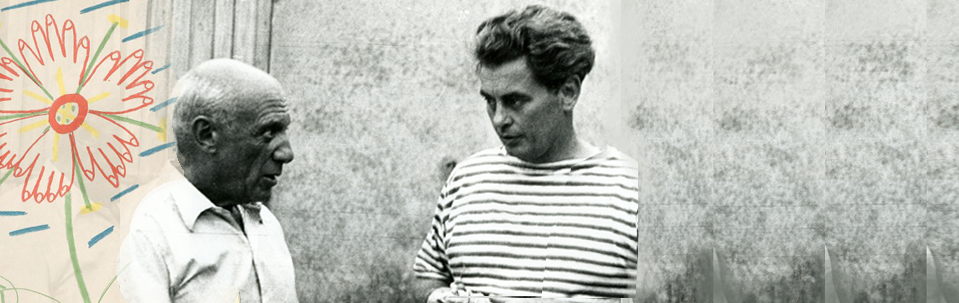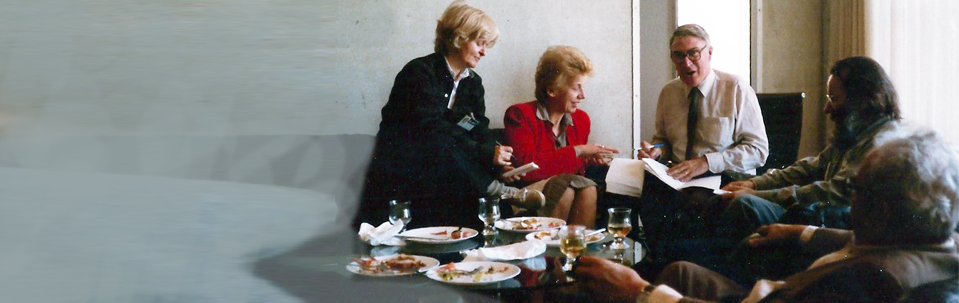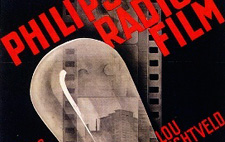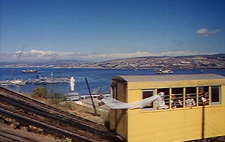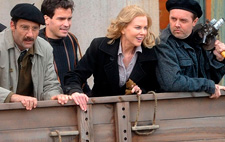



On October 10, 2025, Caroline Hoebens received her Ph.D. from Utrecht University for a dissertation on the film music in the films of Joris Ivens. This marks the first time that the music and sound, as employed by Ivens in his films, have been the subject of a comprehensive study. Joris Ivens himself played the piccolo, a small transverse flute, which may explain his sensitivity to the use of music. Wind instruments, in particular, play such an important role in the music for A Tale of the Wind (1988), composed by Michel Portal. As a true avant-gardist, Ivens loved experimenting with the use of sound and music. For instance, he produced the first sound film in the Netherlands with Philips-Radio (1931), commissioned Lou Lichtveld to compose music for his silent film Rain in 1932, and collaborated with renowned composers such as Hanns Eisler in 1933 in Magnitogorks (Song of Heroes) and Dmitri Shostakovich. This resulted, among other things, in the first film music composed using Schönberg’s twelve-tone technique (The 400 Million) and for Regen (Rain, 1929).
Caroline Hoebens holding her diploma, with the applauding professors behind her.
Caroline Hoevens writes in her “Foreword and Acknowledgments”: “The idea to submit a dissertation proposal was encouraged by Professor Philippe Cathé. Between 2012 and 2014, he supervised my master’s research at the Sorbonne in Paris. During his courses, he had repeatedly expressed his enthusiasm for Dutch cinema and the work of Joris Ivens, who lived in Paris for many years and is perhaps the best-known Dutch filmmaker in France. Thanks in part to his suggestions for relevant research topics and his advice, the proposal was approved in 2017. Professor Cathé supervised me during the first years of my doctoral studies, when I laid the groundwork for the research. I would like to thank him first and foremost for this.
The inspiring conversations with André Stufkens, director of the Joris Ivens Institute, were particularly significant during the preliminary research. He convinced me of the relevance of the issue by pointing out the striking musical fragments in Ivens’ oeuvre. During the same period, Bert Hogenkamp, a media historian and specialist in Dutch documentaries, shared his thoughts with me on conducting research into music in Ivens’ documentaries. I am therefore grateful to both of them, as well as to the staff at the Prince Bernhard Culture Fund and the Dr. Hendrik Muller’s Vaderlandsch Fund for their confidence in the project’s success.
At the end of 2020, when most public institutions in Paris had closed their doors for an extended period and social activities were strongly discouraged, I found myself with my back against the wall because I realized I would not be able to write the dissertation in French as I had planned in 2017. In February 2021, I therefore decided to try to conduct the research and to complete my doctoral studies at the Univrsity if Utrecht. I wrote a letter to musicologist and professor Emile Wennekes. He had published several articles on music in Dutch film. Emile immediately showed interest in what I had written so far. He was open to supervising the final phase of my dissertation, which, as it turned out, took longer than anticipated. Without his commitment and without his comments, remarks, and additions, I would have given up. I am therefore deeply grateful to him. I would also like to thank the assistant supervisor of the research, Michiel Kamp, for his advice and feedback.
Friends, academics, doctoral candidates, and musicians—including Ariadna Alsina Tarrés, Yvan Adriano Zetina Ríos, Virginia Mendez, Andrés Felipe Molano Ruiz, and Jordi Olivar—contributed to identifying specific musical excerpts, understanding the (cultural) significance of certain pieces or genres, and translating Spanish-language (song) lyrics. I met some of them on the campus of the Cité Internationale Universitaire de Paris, where I stayed for a large part of my research and drew much inspiration. Géraud Guilloud, Sébastien Marrec, and Yann-Riccardo Bertrand helped me write the French-language academic texts. There are certainly more people who provided me with advice or shared an idea with me that I made generous use of, but whose names I have forgotten or have not included.
I would like to express my gratitude to all of them. My final thanks go to my sister, Roos Hoebens. From the beginning to the end of the research, she helped me by proofreading my texts, catching weak phrasing, and offering modest suggestions regarding content. She did all this despite having little interest in the study of film or music and having majored in history. Without her substantial contribution, the final result would have taken even longer to materialize. My thanks to Roos are shared with my parents, who have always been there to assist me in arranging or resolving practical matters and problems so that I could carry out this research, and to listen to my ideas, plans, and doubts, responding with encouragement or helping me see things from a different perspective.'
The dissertation Music in the Documentaries of Joris Ivens is available for download via Open Access.